
Research
ESTABLISH ACCESS AGREEMENTS BETWEEN RESEARCHERS AND COMPANIES PROVIDING PRECISE OS-INTEGRATED SCREEN TIME MEASUREMENTS
Following the completion of our synthesis report reviewing the major studies conducted since 2000 to measure the amount of time young people spend on screens, we highlighted the difficulty of obtaining reliable measurements.
Most of the research papers we reviewed relied on surveys conducted specifically for each study by the research teams themselves. Their scope is therefore limited, both by sample size and by the relative reliability of screen time measurements. Screen time is typically measured through questionnaires completed by parents. However, parents are not always present when their children are using screens. They may also lack objectivity due to fear of social judgment if their children are perceived as spending too much time on screens[1].
As a result, researchers often obtain biased or even unusable datasets. On the other hand, most smartphone manufacturers provide operating systems that record daily screen time, with a detailed breakdown of time spent on each application. This data is therefore highly precise and relatively easy to access.
We recommend the creation of partnerships between researchers and companies developing operating systems so that these screen time data can be made accessible to medical research.
When researchers wish to measure mobile device screen time (smartphones, tablets, etc.), instead of sending questionnaires to parents, a partnership program would allow young users or their parents to grant researchers access to their screen time data directly from their mobile devices. Screen time data collection conducted in compliance with the GDPR framework would thus be precise and reliable.
Note 1:
Time spent watching television cannot be measured in the same way, as television use is not individual, unlike the use of tablets, computers, and smartphones.
Note 2:
If obtaining such agreements were to encounter significant obstacles, we believe it would be possible to create applications allowing volunteer parents to share these data with researchers more easily, or even automatically[2].
Note 3:
Major issues such as:
- personal data protection
- consent of minors and their families
- risks related to data surveillance and security
must be taken into account when designing this measure.
- Wolfers, L. N., Nabi, R. L., & Walter, N. (2024). Too Much Screen Time or Too Much Guilt? How Child Screen Time and Parental Screen Guilt Affect Parental Stress and Relationship Satisfaction. Media Psychology, 28(1), 102–133. https://doi.org/10.1080/15213269.2024.2310839
- See, for example, the Stay Free application: https://stayfreeapps.com/
ADOPT A STANDARD DEFINITION FOR CHILDREN’S SCREEN TIME
As highlighted by a study published in 2020, The Conceptual and Methodological Mayhem of “Screen Time”[1], scientists still lack a common, clear, and rigorous definition of screen exposure time.
This absence of a standard definition of screen time[2] across research papers represents a highly problematic limitation. How can studies using different methodologies be rigorously compared? It becomes impossible to accurately track changes in children’s screen time over long periods. To address this issue, it is necessary to reach a consensus on the definition of screen time and to establish a common measurement protocol. The measurement challenge can be partially resolved through the implementation of our first recommendation.
We recommend using the following two definitions:
Screen time
Screen time refers to the total duration spent in front of a screen, across all devices combined (televisions, computers, game consoles, smartphones, and tablets), when active visual attention is required.
Included:
- Consumption of audiovisual content (films, series, videos, streaming)
- Use of social media, video games, or interactive applications
- Web browsing or consultation of digital content (websites, e-books, etc.)
Excluded:
- Background usage (music, podcasts, audio calls)
- Utility applications (GPS, calculator, productivity tools) that do not require continuous visual attention
- Phone calls (excluding video calls)
Mobile device screen time
Mobile device screen time corresponds to the cumulative duration spent actively using applications that require continuous visual attention from the user.
Included:
- Social media applications (Instagram, TikTok, Facebook, etc.)
- Video streaming applications (YouTube, Netflix, Twitch, etc.)
- Mobile games
- Reading or web-browsing applications (web browsers, news apps, etc.)
- Any other application whose primary use relies on visual interaction with the screen
Excluded:
- Navigation applications (Google Maps, Waze, Mappy, etc.), primarily used for real-time directions
- Music or podcast applications running in the background (Spotify, Deezer, Apple Music, etc.)
- Telephony applications (voice or video calls)
- Utility applications (calculator, notes, reminders, etc.) or those whose use does not require prolonged visual attention
- Kaye, L. K., Orben, A., Ellis, D. A., Hunter, S. C., & Houghton, S. (2020). The Conceptual and Methodological Mayhem of “Screen Time”. International Journal of Environmental Research and Public Health, 17(10), 3661. https://doi.org/10.3390/ijerph17103661
- Screen time and screen exposure time are considered semantically equivalent.
Inform
DISSEMINATE PUBLIC AWARENESS CAMPAIGNS LED BY PUBLIC HEALTH MINISTRIES TO RAISE AWARENESS OF THE DANGERS OF OVEREXPOSURE
Studies suggest that the majority of parents do not take pediatric recommendations regarding screen time into account. We believe that a particular effort is needed to disseminate these recommendations as widely as possible. We therefore propose the implementation of a public health policy based on advertising campaigns and legislation consistent with pediatric recommendations.
An advertising campaign supported by public health ministries in different countries would help bring pediatric screen time recommendations back to the attention of parents and educators.
Regarding legislation, we believe it is important to encourage each country to leverage relevant contributions from national and supranational digital regulatory authorities. These authorities regularly publish detailed reports (some of which are included in our synthesis work) that can be used to support the necessary legislative measures.
Build
CREATE A RANKING OF MOBILE AND SOFTWARE APPLICATIONS BASED ON AVERAGE USER TIME SPENT, MODELED AFTER THE PEGI RATING SYSTEM
Despite methodological differences between studies, scientists worldwide agree that too large a proportion of children and adolescents do not comply with pediatric screen time recommendations. We therefore propose informing users, parents, and educators about the potentially “addictive” or time-consuming nature of applications, while remaining neutral and factual.
To achieve this, we have envisioned a ranking of mobile and software applications based on average user time spent, modeled after the PEGI rating system[1]. This ranking, called TEMPO (TIMESCORE in English), would measure average engagement time per application.
The objectives of this label—summarized as “Know more to better manage screen time”—would be:
- Transparency: Provide clear, standardized information on the average daily time users spend on each application
- Awareness: Help users become aware of their digital consumption
- Tools for parents/educators: Enable informed choices for applications intended for children or adolescents
- Encouraging moderation: Encourage developers to integrate digital well-being features (e.g., break reminders, usage dashboards)
To establish this ranking, anonymized and aggregated data (via partnerships with platforms such as Apple Screen Time, Google Digital Wellbeing, or independent studies) collected from children’s and adolescents’ devices would be used.
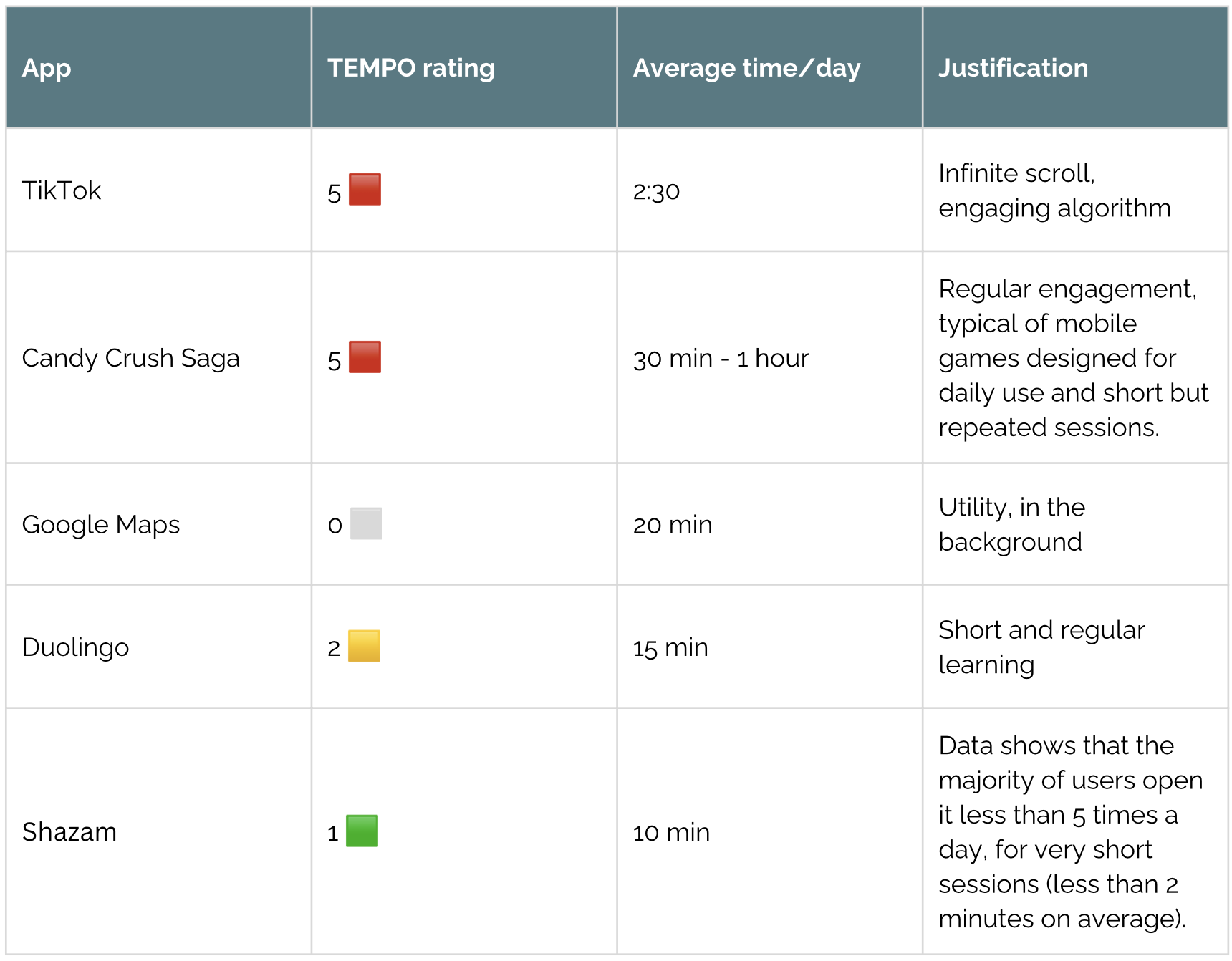
These data would be supplemented by voluntary user surveys conducted through a dedicated application or website, as well as public data (company reports, academic studies). The average daily usage time over the past 12 months could serve as the reference period.
The ranking would assign a score (from 1 to 5) based solely on the average daily time spent on the application, excluding background activity time. Applications in the utility, music, or navigation categories would be excluded from the ranking due to their specific usage patterns.
In practice, a pictogram corresponding to the score would be displayed on app stores (App Store, Google Play) next to ratings and reviews. A detailed information sheet would be accessible via a click, providing additional data (age distribution, built-in well-being features, etc.). Finally, to reflect changes in usage patterns, these rankings could be updated quarterly.
- The PEGI rating system is a European video game classification system designed to help players, and especially parents, make informed choices. It indicates one of the following age categories: 3, 7, 12, 16, 18.